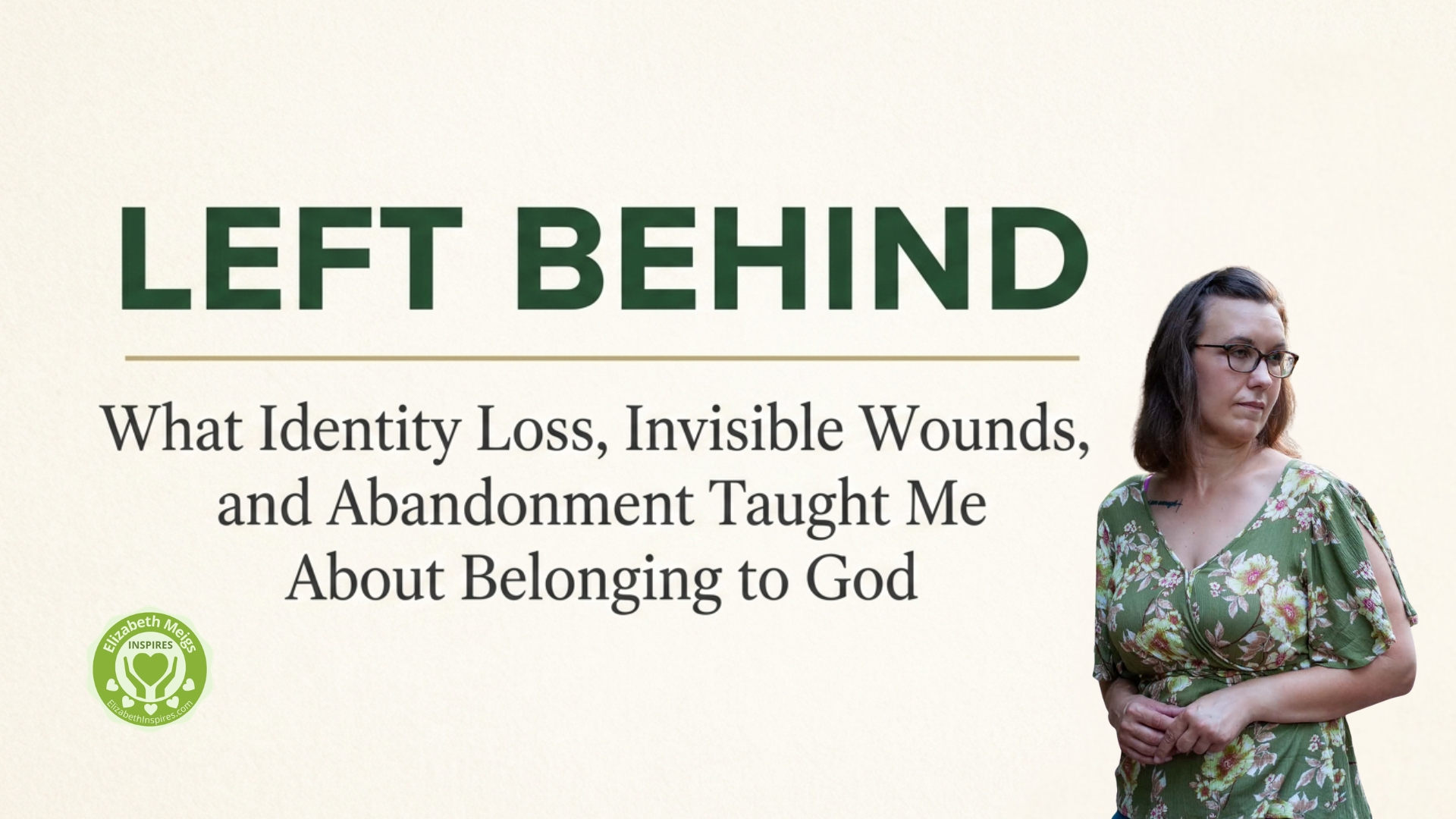
Left Behind: What Identity Loss, Invisible Wounds, and Abandonment Taught Me About Belonging to God
Left Behind
What Identity Loss, Invisible Wounds, and Abandonment Taught Me About Belonging to God
By Elizabeth Meigs | Certified Trauma-Informed Practitioner | Transformational Coach & Speaker | Founder of Elizabeth Inspires | Creator of the Miracle Power Activation System™
There's a moment I keep coming back to.
I'm fourteen. One week into my freshman year of high school. And in a single instant — a car accident, a traumatic brain injury, doctors telling my family to prepare to say goodbye — the girl I'd been my whole life was gone.
I lived. But I didn't come back the same.
I've told pieces of this story for fourteen years now — on stages, in hospital rooms, in small groups, in quiet conversations with people who needed to know they weren't crazy for feeling what they were feeling. It's not a rare thing for me to share. It's just my story, and I keep telling it because it keeps helping people name what they're carrying.
But I've never laid out the whole arc in one place like this before — how losing my identity, fighting a battle nobody could see, and being quietly left behind by the people I loved were actually three parts of the same season. So that's what I want to do here. Not because the details are new, but because I think you need to see how they connect.
If you're a veteran, a first responder, a healthcare worker, a trauma survivor, or a leader who's exhausted from holding it together for everyone else — I think you'll recognize more of this than you expect.
Losing the Thing That Made Me, Me
I was known as the girl with the voice. Singing wasn't a hobby — it was my identity — my dream, my heart.
Then in one moment, the very thing that made me me was taken from me. Not as some metaphor. Literally. My voice.
I didn't speak for 43 days. Then a whisper. It took 8 months to speak in full sentences again.
When my voice finally returned, I did the only thing I knew to do — I got back to singing, thinking if I could just do the thing again, I'd feel like myself again. And it gave me something real. It gave me something. One place I wasn't judged. One place I wasn't rejected. The only light I had through years of a hard season.
But it didn't answer the real question. And singing was never going to.
Who am I now? Not "what can I still do." Not "what's left of who I used to be." Who am I, underneath all of it?
I want to pause here, because I think this is where so many of you live too — not because you lost your literal voice, but because you lost something. A career, gone in a layoff. A marriage, gone in a divorce. A uniform, gone the day you took it off for the last time. A body, changed by illness or age. A role, stripped away by burnout.
And underneath every version of that loss is the exact same quiet question: Who am I, if not what I do?
Here's what I eventually learned, and it didn't come quickly or easily: I didn't find the answer in getting my old identity back. I found it in realizing I was never meant to rebuild the old one at all. Scripture says it plainly — "Therefore, if anyone is in Christ, he is a new creation. The old has passed away; behold, the new has come" (2 Corinthians 5:17). And later, in a much harder season of my life, I'd learn it again a different way: "I have been crucified with Christ. It is no longer I who live, but Christ who lives in me" (Galatians 2:20).
My identity had to move. Not from what I did to what I could still do. From what I did — to whose I am.
The War Nobody Could See
Here's the part almost nobody talks about. My body had a finish line. The bandages came off. The wheelchair disappeared. People could see me healing. And I was praised for that.
On the outside the world saw a smile most of the time.
But the war inside me didn't have a finish line like that.
Grief. Fear. Not knowing who I was anymore. None of it showed up on an x-ray — so most people assumed I was fine once I looked fine.
But invisible wounds don't get casseroles or check-ins. That doesn’t mean they don’t matter. They still need to be tended to, just as much as anything you can see.
I remember getting on my knees and asking God why. Not gently. Screaming. Crying. Blaming. "Why did you do this to me? What did I do to deserve this?"
He didn't hand me a five-step plan. He filled me with a comfort, a love, and a peace I had never known before. And His voice of truth accompanied it as He spoke over my heart: "I have a plan for you. You can't stop. You have to keep going."
That's not a promise I made up to sound inspirational. It's rooted in Jeremiah 29:11 — "For I know the plans I have for you, declares the Lord, plans to prosper you and not to harm you, plans to give you hope and a future." And in Psalm 34:18 — "The Lord is near to the brokenhearted and saves those who are crushed in spirit."
If you're a veteran carrying something from deployment that never made it into a report. A nurse who hasn't cried since the shift that broke something in you. A first responder who's "fine" because that's the only acceptable answer at work. A leader who hasn't told a single person how tired you actually are — I want you to hear this clearly: your battle is real, even without visible proof. Even if no one's brought you a meal for it. Even if no one checks in on it the way they would a broken bone.
Coming Home to an Empty Room
I thought coming home from the hospital would be the relief. I thought my friends would be waiting.
They weren't.
My friends kept playing the sports we used to play together. Kept working their weekend jobs. Kept living the lives we used to live side by side. They didn't have time for me anymore. Some didn't seem to care if I was even around.
I want to be precise about what this was, because I think it's the loneliest kind of pain there is: nobody tells you that abandonment doesn't always look like someone walking out the door. Sometimes it looks like everyone simply moving forward... while you're still standing in the wreckage, waiting for someone to notice you didn't make it to where they are yet.
That kind of alone is a quiet one. No one to blame. No dramatic goodbye. Just absence.
I didn't have language for it at fourteen. I just knew I felt forgotten — like the version of me worth including had been left behind at the accident, and no one had bothered to tell me. It would be more than a decade before I fully understood why my friends pulled away. But in that season, all I had was the ache. The anger, the bitterness, the self-hatred, feeling unworthy and undeserving of life and love.
And this is where the verse that's carried me the most came in. "When my father and my mother forsake me, then the Lord will take me up." — Psalm 27:10
He didn't get busy. He didn't forget. He didn't decide I wasn't worth His time the way it felt like everyone else had. "I will never leave you nor forsake you." — Hebrews 13:5
The Thread That Ties It All Together
Here's what I want you to walk away with, because I think it's the whole point of telling you all three pieces at once:
Being left behind takes more than one shape. Sometimes it's losing the thing that made you you. Sometimes it's fighting a war inside yourself that nobody else can see. And sometimes it's watching everyone else's life keep moving while yours feels frozen in place, STUCK.
But every single one of those wounds gets tended to the same way — not by rebuilding what was lost, not by proving your battle is legitimate to people who can't see it, and not by convincing people to come back and wait for you. It gets tended to by moving your sense of self and security off of what you do, what you're carrying, or who stayed — and onto who you've always belonged to.
That shift isn't instant. I'm not going to tell you it happens in a weekend, or that reading this post will resolve something that took me years to work through. It won't. What I can tell you is that it's possible to walk toward that shift with real, practical support — support that works alongside anything else you're already doing for your healing, whether that's therapy, medical care, or both. This isn't a replacement for that. It's meant to stand next to it.
That's exactly why I built what I've built — a faith-anchored system for people who are done performing strength and ready to actually tend to what they've been carrying.
Where to Start
If any part of this hit close — the identity question, the invisible battle, the quiet ache of feeling left behind — start by getting curious about what your body might already be trying to tell you.
Download the free Nervous System Checklist — a simple way to build awareness of the invisible signs your body sends when it's carrying stress. It's a small first step, but it's a real one. https://elizabethinspires.com/nervous-system-checklist/
Remember, you hold the keys to Unlocking your Miracle Power.
By Elizabeth Meigs | Certified Trauma-Informed Practitioner | Transformational Coach & Speaker | Founder of Elizabeth Inspires | Creator of the Miracle Power Activation System™


