Why You’re Not Crazy: Fight, Flight, Freeze, and Fawn Trauma Responses Explained
By Elizabeth Meigs | Certified Trauma-Informed Practitioner | Transformational Coach & Speaker | Founder of Elizabeth Inspires | Creator of the Miracle Power Activation System™
Why You’re Not Crazy: Fight, Flight, Freeze, and Fawn Trauma Responses Explained
Understanding your nervous system, releasing shame, and discovering God’s path to healing.
Have you ever wondered why your reactions sometimes feel bigger than the situation in front of you?
One moment you feel calm.
The next moment you feel overwhelmed, angry, shut down, or anxious.
You might try to control it.
You might tell yourself to “just calm down.”
But your body reacts anyway.
This does not mean something is wrong with you.
It means your brain learned how to protect you.
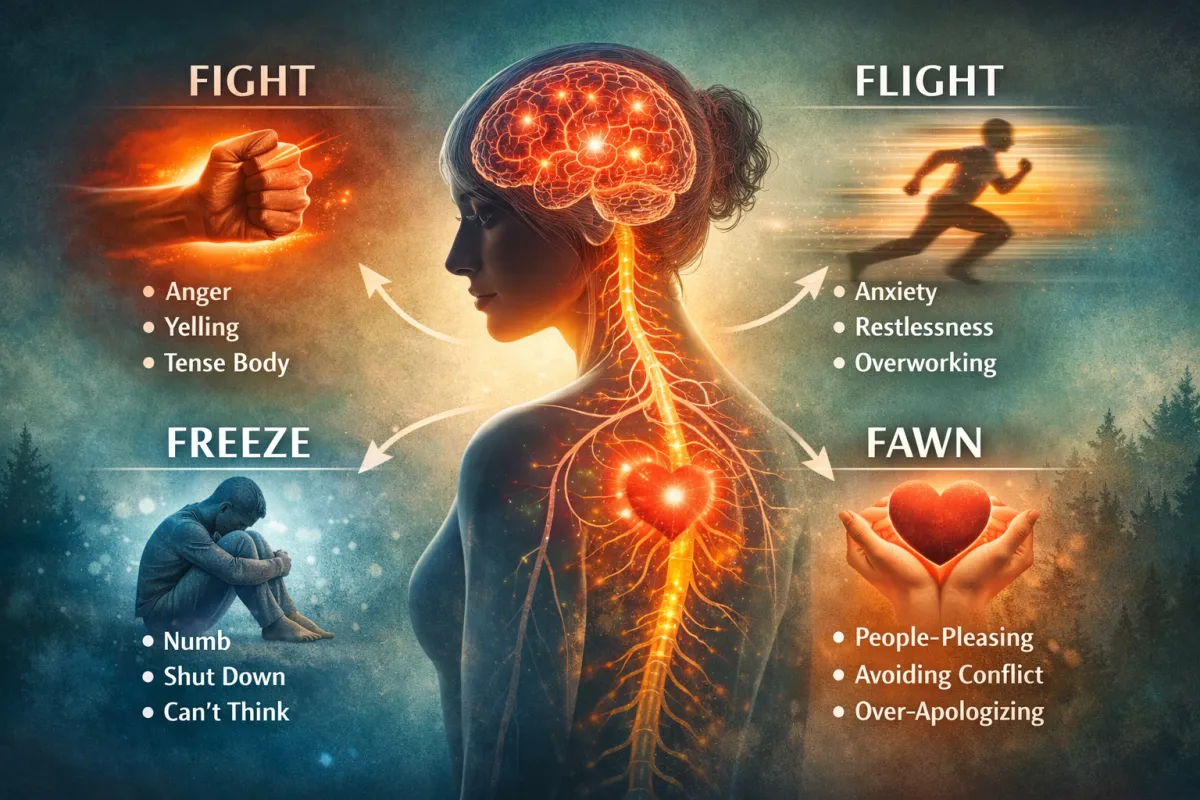
Psychologists call these protection patterns fight, flight, freeze, and fawn.
They are automatic survival responses the brain uses when it believes you might be in danger.
Today we are going to explain these four trauma responses in simple, clear language.
No shame.
No heavy medical terms.
Just understanding.
And we will anchor this truth in Isaiah 41:10:
“Do not fear, for I am with you… I will strengthen you and help you.”
If God says He is with you, then your struggle is not proof He left.
What Is a Trauma Response?
A trauma response is a protection pattern.
When your brain senses danger, it reacts before you think.
This happens in a deep part of your brain designed to keep you alive. It scans for threat all day long.
If it thinks something is unsafe, it pushes a reaction.
Not because you are weak.
Because you survived.
The Four Protection Patterns
1. Fight
Fight says:
“If I push back, I might be safe.”
Fight can look like:
Anger
Defensiveness
Raising your voice
Emotional outbursts
Feeling overwhelmed and reacting quickly
After my brain injury in high school, I learned how to hold everything together during the day.
At school, I did the therapy.
I did the assignments.
I tried to function normally.
But when I got home, everything I had been holding inside would come out.
Sometimes it came out as anger.
Sometimes it came out in tears.
I had been holding everything together all day.
Eventually the pressure had to release somewhere.
Many trauma survivors experience this.
They hold everything together in public, but fall apart at home where it finally feels safe to release what they have been carrying.
2. Flight
Flight says:
“If I stay busy, I do not have to feel this.”
Flight can look like:
Staying constantly busy
Filling your schedule
Avoiding painful conversations
Throwing yourself into work or responsibilities
Keeping your mind occupied
Later in my life, I noticed this pattern in my marriage.
Instead of slowing down and facing the pain, I stayed busy.
Busyness helped me avoid thinking about the hurt I was feeling.
Sometimes flight is not running away physically.
Sometimes it looks like productivity.
Sometimes it looks like responsibility.
But underneath the activity is often a nervous system trying to escape emotional pain.
3. Freeze
Freeze says:
“If I shut down, I might be safe.”
Freeze can look like:
Feeling numb
Brain fog
Difficulty making decisions
Going quiet
Feeling stuck
When the nervous system becomes overwhelmed, it sometimes slows everything down.
It is like a circuit breaker in the brain.
Instead of reacting with energy like fight or flight, the body conserves energy by shutting down.
This is not laziness.
It is protection.
4. Fawn
Fawn says:
“If I keep them happy, I will be safe.”
Fawn can look like:
People-pleasing
Apologizing often
Ignoring your own needs
Trying to keep everyone calm
Avoiding conflict at all costs
This response showed up strongly for me after my brain injury in high school.
At school, I tried to be easy to work with.
I tried not to cause problems.
I tried to make things easier for everyone around me.
Later, I noticed the same pattern in my marriage.
Part of me believed that if I kept my husband happy, I could keep the peace.
So I tried to please him.
I tried to avoid conflict.
I tried to smooth things over.
Fawn and flight often work together.
One part of you stays busy to avoid pain.
Another part of you tries to keep everyone else comfortable.
Neither response means you are weak.
They mean your nervous system was trying to survive.
Your Nervous System Was Doing Its Job
Fight, flight, freeze, and fawn are not personality flaws.
They are survival responses.
Your brain is designed to protect you. When it senses danger, it reacts quickly—often before you have time to think.
That reaction might look like anger.
It might look like shutting down.
It might look like staying busy.
Or trying to keep everyone happy.
For people who have experienced trauma, the brain’s alarm system can become more sensitive. It may react strongly even when the present moment is not truly dangerous.
Understanding this changes something important.
Instead of asking,
“What is wrong with me?”
You can begin asking,
“What has my body been trying to protect me from?”
That shift removes shame.
And once shame begins to lift, healing becomes possible.
Faith Reminder: God Has Not Left You
When we are overwhelmed, it can feel like we are alone.
But scripture reminds us of something powerful.
In Isaiah 41:10, God says:
“Do not fear, for I am with you. Do not be dismayed, for I am your God. I will strengthen you and help you.”
Notice what God does not say.
He does not say,
“Fix yourself first.”
He says,
“I am with you.”
Healing is not something you have to force alone.
It is something you walk through with God.
And step by step, your nervous system can learn that it is safe again.
When It Feels Like You’re Losing Control
One of my clients, a trauma survivor, came to me crying.
They were cycling between fight, fawn, and freeze.
At home there was manipulation, confusion, and emotional chaos.
Their reactions felt unpredictable.
Sometimes they cried and didn’t understand why.
Sometimes they became angry.
Other times they shut down or tried to please everyone around them.
Because of the manipulation they were experiencing, they began to question themselves.
They started wondering if something was wrong with them.
At times they even feared they might be “crazy.”
But the truth was very different.
Their reactions were survival responses to ongoing emotional stress.
When they began to understand this, something important changed.
They stopped fighting themselves.
For the first time, they realized they were not crazy.
Their mind and body had been trying to survive.
And that is when real healing could finally begin.
The Turning Point
My turning point came during a breakdown.
I had been holding so much inside for so long.
Eventually, everything surfaced at once.
But in that moment, something else happened too.
I began to feel God’s presence, His reassurance.
He had not left me.
Isaiah 41:10 became real in a way it never had before.
“Do not fear, for I am with you… I will strengthen you and help you.”
The enemy may have tried to stop me and keep me stuck in the damage.
But God was not finished with my story.
He began rebuilding what had been broken.
Little by little, He reminded me that my life still had purpose. His greater plan.
I realized I could not stay stuck in the pain.
This was about more than just me.
God was calling me to rise.
At the time, I didn’t understand trauma responses or the nervous system. I only knew that God had stepped into my brokenness and begun rebuilding my life.
Years later, when I became a trauma-informed practitioner, I finally understood the patterns behind reactions like fight, flight, freeze, and fawn.
Awareness Brings Power
My client had a shift too.
They chose to rise.
They began learning to reframe.
Reframe means to look at a thought from a new angle.
Instead of:
“I’m broken.”
They learned to say:
“My body is protecting me.”
Perspective gave them power.
Awareness reduced shame.
Regulation skills calmed the spirals.
Slowly, fight softened.
Freeze shortened.
Fawn decreased.
Healing began.
But it took more than just one choice.
It required asking for help, seeking support, and choosing to step out of the chaos.
Because the truth is, we were never meant to do life alone.
Scripture reminds us in Ecclesiastes 4:9–10:
“Two are better than one… If either of them falls, one can help the other up.”
Healing often begins when we allow someone to walk beside us.
And when we begin to understand our patterns and seek the right support, real transformation becomes possible.
The Pathway Forward
Many people understand their trauma responses, but they still don’t know how to move from survival into lasting peace.
Healing does not happen by shaming your reactions.
Healing happens when you understand them and begin retraining your mind, body, and spirit.
Inside the Miracle Power Activation System™, there are three core frameworks that work together to support healing and lasting transformation.
The Pathway to PEACE Method™ is the foundation.
It helps calm the nervous system and return the body to a place of peace.
The Roadmap to Resilience™ focuses on identity restoration.
It helps you recognize the lies trauma created and rebuild the truth about who you are.
The Miracle Power Activation™ framework brings faith, identity, and daily rhythms together so transformation becomes sustainable in everyday life.
Together, these frameworks help move a person from survival patterns into stability, clarity, and purpose.
Healing is not about forcing yourself to change.
It is about learning new patterns that allow your mind, body, and spirit to work together again.
Never forget—you hold the keys to unlocking your Miracle Power™.
You Are Not Crazy
You are not dramatic.
You are not weak.
You adapted.
Your nervous system learned how to survive.
Now it can learn how to feel safe again.
And you do not have to do that alone.
Isaiah 41:10 reminds us:
God strengthens.
God helps.
God upholds.
Healing is not self-effort alone.
It is a partnership.
The same God who promises in Isaiah 41:10 to strengthen and help you is still walking with you as you heal.
Affirmations for When Shame Rises
My reactions make sense.
My body was protecting me.
I am not broken.
I can learn new patterns.
God has not left me.
I am rising.
My past is not my destiny.
If these words feel grounding, I invite you to sign up for my daily affirmations text subscription:
https://elizabethinspires.com/subscribe-to-daily-affirmations/
And if you feel ready to go deeper, I will soon be opening Founding Member Beta spaces for a new experience built around the Miracle Power Activation System™.
If you would like to learn more, you can visit the page below for details.
You are also welcome to book a Discovery Call if you have questions or would like to explore whether this opportunity may be a good fit for you.
https://elizabethinspires.com/miracle-power-activation-system-cohort/
You are not crazy.
You are becoming aware.
And awareness is the beginning of freedom.
Just as Isaiah 41:10 promises, you do not have to walk this healing journey alone.
Don’t forget that you hold the keys to unlocking your Miracle Power™.
If you want to dive deeper and really soak this in listen to the latest Episode of the Untrapped: Healing Invisible Wounds to Living your Dreams Podcast
Click here to listen to Episode 10, and subscribe today to never miss an episode!


