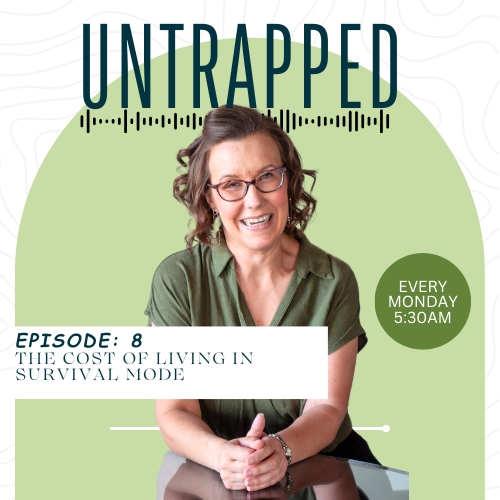
The Cost of Living in Survival Mode: How God Restores What Trauma Tried to Redefine
By Elizabeth Meigs | Certified Trauma-Informed Practitioner | Transformational Coach | Founder of Elizabeth Inspires | Creator of the Miracle Power Activation System™
What Chronic Stress Over Time Does to Your Nervous System, Identity, and Faith
There is a difference between surviving something… and living in survival mode.
Survival saves your life in a crisis.
But living in survival mode slowly steals it back.
And most high-capacity leaders, caregivers, veterans, first responders, trauma survivors, and faith-driven professionals don’t even realize they’re doing it.
They call it:
“Pushing through.”
“Being strong.”
“Handling it.”
“Keeping the faith.”
“Just a busy season.”
But underneath the language of resilience is often something far more costly:
Chronic stress over time.
And chronic stress is not neutral.
It changes your brain.
It changes your body.
It changes your relationships.
It even distorts how you see God.
Let’s talk about what’s really happening.
What Does “Living in Survival Mode” Actually Mean?
Living in survival mode means your nervous system never fully powers down.
It stays braced.
Scanning.
Preparing.
Anticipating the next threat.
Even when there isn’t one.
This is what happens when trauma and survival patterns go unprocessed. The body doesn’t know the danger is over — so it keeps protecting you.
Survival mode and the nervous system are directly linked. When your brain perceives threat (physical, emotional, relational, or spiritual), it activates your stress response.
That response was designed for short bursts.
Not decades.
The Effects of Chronic Stress Over Time
Let’s break this down physiologically.
When you’re living in survival mode, your body releases cortisol and adrenaline.
In a healthy cycle:
Stressor appears.
Cortisol rises.
You respond.
Cortisol drops.
The body returns to baseline.
But with chronic stress over time, that cycle never completes.
This is where cortisol and chronic stress begin to create long-term damage.
What Happens Instead?
Cortisol stays elevated.
Sleep becomes disrupted.
Inflammation increases.
The nervous system becomes overloaded.
Emotional regulation weakens.
Autoimmune responses can flare.
Mental clarity declines.
The body was never designed to run on emergency fuel 24/7.
Signs You’re Living in Survival Mode (Even If You Look “Fine”)
Many high-functioning people don’t realize they’re experiencing nervous system overload because they still show up.
They still perform.
They still lead.
But inside?
You might recognize:
Emotional numbness
Anger you can’t explain
Emotional outbursts followed by shame
Breaking down crying unexpectedly
Insomnia
Irritability
Brain fog
Resentment
Shutdown cycles
Autoimmune flare-ups
Mental and emotional fatigue
Emotional exhaustion symptoms that don’t go away with a weekend off
These are signs of nervous system dysregulation.
Not weakness.
Not lack of faith.
Not failure.
These are signs your body has been protecting you for too long.
Why Survival Mode Is Not Sustainable
You can survive almost anything for a season.
But survival mode and chronic stress over time come with a cost:
1. Identity Erosion
When you live braced long enough, you forget who you are without armor.
You become:
The strong one.
The fixer.
The dependable one.
The leader who doesn’t break.
But inside, you’re exhausted.
Living in survival mode slowly shifts identity from who God created you to be to who trauma required you to become.
2. Emotional Exhaustion
Burnout and chronic stress look similar on the surface.
But burnout is often situational.
Chronic stress over time is systemic.
It changes your baseline.
You don’t just feel tired — you feel empty.
That’s emotional exhaustion.
3. Nervous System Overload
When the nervous system doesn’t get restoration, it begins to malfunction.
You may swing between:
Hyperarousal (anxiety, anger, urgency)
Hypoarousal (shutdown, numbness, withdrawal)
This is not character failure.
It’s physiology.
My Personal Proof: Twelve Years in Survival Mode
For me, living in survival mode looked like:
Emotional numbness.
Anger I couldn’t control.
Emotional outbursts followed by deep shame.
Crying breakdowns.
Insomnia.
Irritability.
Illness.
Shutdown cycles.
Resentment.
Brain fog.
For nearly 12 years after my accident, survival mode was my baseline.
With the first 5–6 years I was in a constant spiral — daily, weekly, monthly.
I was functioning.
But I was not living.
Then one day in desperation, I cried out to God:
“Why did You do this to me? What did I do to deserve this?”
And He answered.
Not with explanation.
With a promise.
“I have a plan for you. You can’t stop. You have to keep going.”
In that moment, it was no longer about me.
He overwhelmed me with comfort, love, and peace.
That was everything I needed in that moment.
Every time I spiraled in the six years that followed, He overwhelmed me again.
That is not poetic language.
It was physiological.
Peace would flood my body.
My breathing would slow.
My mind would quiet.
That is what restoration feels like in the nervous system.
Psalm 23 wasn’t something I was trying to apply.
It was something God was living out over me.
Psalm 23 and the Nervous System
“The Lord is my shepherd, I lack nothing.
He makes me lie down in green pastures,
He leads me beside still waters,
He restores my soul.”
Psalm 23 rest and restoration is not metaphorical.
Look at the sequence:
He makes me lie down.
He leads me beside still waters.
He restores my soul.
Rest precedes restoration.
Not hustle.
Not striving.
Not proving.
Living in survival mode resists lying down.
The nervous system only heals in safety.
And Psalm 23 is a safety narrative.
Even later — decades after my accident — when I entered a marriage that became manipulative and emotionally abusive, God’s unfailing love pursued me again.
Two and a half years in, He spoke clearly:
“If you are going to fulfill my will. You cannot stay here. You have to go.”
He made a way.
He reminded me what love actually looked like.
That is restoration.
Not survival.
The Long-Term Effects of Stress on the Body
If you’ve been living in survival mode, here’s what chronic stress over time may be doing:
Increased inflammation
Hormonal imbalance
Compromised immune function
Sleep disruption
Digestive issues
Increased anxiety sensitivity
Memory impairment
Emotional reactivity
Decision fatigue
Spiritual disconnection
The body keeps score.
But it also responds to safety.
Healing the nervous system naturally is not mystical.
It’s measurable.
Trauma and Survival Patterns
Trauma creates survival patterns that once protected you:
Hyper-independence
Emotional suppression
Overachievement
Control
Avoidance
People-pleasing
But what protected you in crisis can imprison you in peace.
Living in survival mode long-term convinces you that:
Rest is unsafe.
Slowing down is irresponsible.
Vulnerability is dangerous.
Strength equals suppression.
That is not resilience.
That is adaptation.
Healing From Chronic Stress Is Possible
Here’s the hope:
The nervous system can recalibrate
Stress and burnout recovery are possible.
Finding peace after burnout is possible.
But healing from chronic stress requires:
Awareness.
Safety.
Regulation.
Rebuilding identity.
Integrating faith with physiology.
This is why in the Pathway to PEACE Method™, we begin with awareness and nervous system stabilization before identity rebuilding.
And in the Roadmap to Resilience™, we don’t skip the rest phase.
You cannot build purpose on top of exhaustion.
How to Stop Living in Survival Mode
You don’t shame yourself out of survival mode.
You create safety.
Practical starting points:
Prioritize sleep restoration.
Reduce unnecessary inputs.
Practice slow breathing daily.
Limit trauma-triggering media.
Increase predictable rhythms.
Invite God into regulation moments — not just crisis moments.
When David writes, “He restores my soul,” the Hebrew word for restore means “to bring back to original condition.”
That includes your nervous system.
Faith and Healing From Stress
Faith does not cancel biology.
But it absolutely transforms it.
When you feel safe in God’s presence, your body responds.
Oxytocin increases.
Cortisol decreases.
Heart rate stabilizes.
Peace is not imaginary. It is embodied.
The Shepherd does not drive. He leads. And sheep only lie down when they feel safe. If you cannot rest, it may not be a spiritual failure. It may be nervous system overload.
Awareness Is the First Step
If this post feels uncomfortably familiar, that’s not accidental. Many people live in survival mode for years before realizing:
“This isn’t sustainable.”
You were designed for resilience. Not perpetual emergency. You were designed for purpose. Not constant bracing. And survival mode, while necessary in crisis, is not meant to be your identity.
You Don’t Have to Figure This Out Alone
If you’re recognizing the signs of nervous system dysregulation, emotional exhaustion, or burnout and chronic stress in your life, start with something small.
I created a free resource to help you interrupt survival mode quickly:
The 30-Second Secret to Unlock Your Personal Peace
It’s simple. Practical. Grounded in physiology and faith.
You can access it here:
https://elizabethinspires.com/30-second-secret/
If daily reinforcement helps you stay regulated, you can also join my daily affirmations text subscription:
https://elizabethinspires.com/subscribe-to-daily-affirmations/
If this stirred something in you, I unpack this more deeply on my podcast, where I teach trauma-informed stress recovery, faith-centered healing, and how to rebuild your identity after trauma. Listen to Untrapped: Healing Invisible Wounds to Living Your Dreams on your favorite platform, or visit: https://elizabethinspires.com/podcast-1/.
In Episode 8, The Cost of Survival I go deeper—breaking down what’s happening in your nervous system, sharing personal proof from my own journey, and offering real hope that healing is not only possible, it’s practical.
If you’re ready to move from surviving to steady strength, start there.
(Link to episode below)
Final Truth
Living in survival mode may have saved you.
But chronic stress over time will slowly diminish you if left unaddressed.
Psalm 23 is not just comfort poetry.
It is a blueprint.
He leads.
He restores.
He prepares.
He anoints.
Your cup overflows.
Survival is reactive.
Restoration is intentional.
And you were not created to merely survive.
You were created to overflow.
Click Image to listen!